 Next target: Brazil
Next target: Brazil
Next target: Brazil
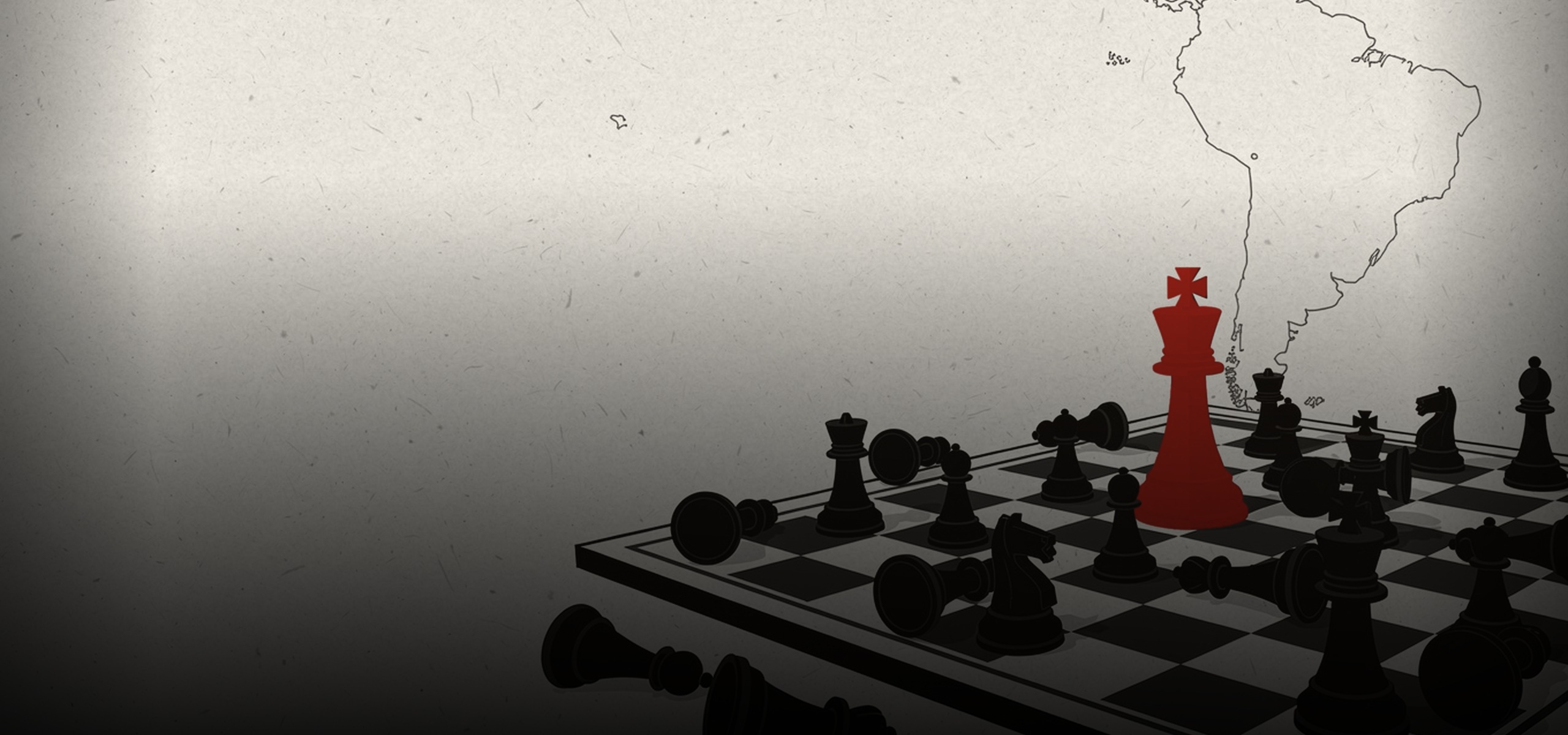
Brazil votes on October 4 and the race is tied within one point. What almost nobody is saying is that Brazil is not what is at stake there: what is at stake is the last pillar of a project that began in São Paulo thirty-six years ago. And what happens that Sunday reaches Mexico sooner than you think.
On Sunday, October 4, Brazil votes. The latest Nexus poll for BTG Pactual, taken between July 31 and August 2, gives Lula 46 percent and Flávio Bolsonaro 45.
One point. Inside the margin of error. Two weeks ago the gap was four.
But this essay is not about who wins. It is about why that election matters more than any other on the continent, and why its result will reach Mexico before next year's midterms.
I am going to tell you a story that starts in 1990, in a hotel ballroom in São Paulo, and ends next year on a Mexican ballot. It is all connected. I will show you step by step.
And I will start with the simplest part, because without it the rest makes no sense.
Imagine you have just lost the war. Not a battle: the entire war.
That was 1989 for the Latin American left. In November the Berlin Wall came down. Two years later the Soviet Union dissolved. And overnight everything disappeared at once: the money, the model and the argument.
It is worth measuring what that meant, because today it reads like a textbook fact and at the time it was a cataclysm.
Cuba lost the Soviet subsidy that sustained its entire economy and entered what was called the Special Period: twelve-hour blackouts, Chinese bicycles instead of buses, real hunger. Central American armed movements lost their patron just as they were negotiating demobilization. Communist parties across the continent, which had spent seventy years explaining the world with one manual, were left without a manual.
To anyone watching from outside, the matter was settled. Francis Fukuyama published his essay on the end of history that same year. The general conclusion was that the Latin American left would suffocate.
In July 1990, in a São Paulo hotel, a Brazilian union leader who had lost two presidential elections called together everyone who was left.
Delegations came from nearly the whole continent. Brazil's Workers' Party as host, the Communist Party of Cuba, the Sandinista Front, the Farabundo Martí Front, Uruguay's Broad Front, and a constellation of small parties that governed nothing at the time.
Nobody paid much attention. It was a group of losers in a hotel ballroom.
Abandon armed struggle and compete in elections. Not necessarily out of democratic conviction, but because it was the only road still open.
Each party stays national, but they share diagnosis, calendar, cadres and financing. A network, not a single party. That is why it lasted.
Once in government, reform the constitution, the judiciary and the electoral bodies. Not to govern better, but to make the adversary's return harder.
Build alternative regional blocs and find partners outside the continent. This is the postulate that explains everything that follows.
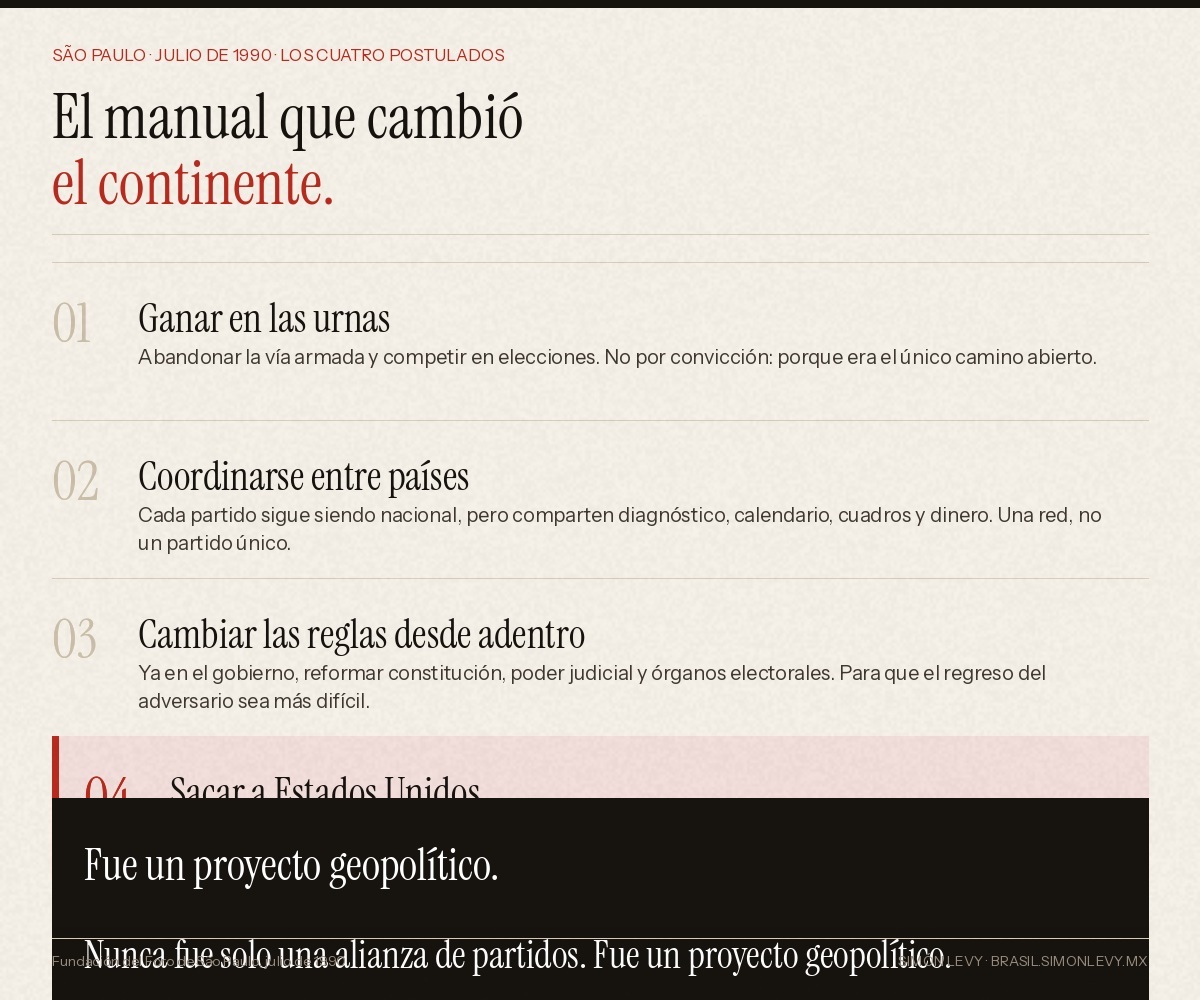
That fourth point is the one almost nobody explains properly, and it is the heart of this essay.
The Forum was never just an alliance of parties. It was a geopolitical project: pull Latin America out of Washington's orbit and into another one.
Now look at the calendar, because the sequence is what is striking.
Hugo Chávez won Venezuela in 1998. Lula won Brazil in 2002, on his fourth attempt. Néstor Kirchner won Argentina in 2003. Tabaré Vázquez won Uruguay in 2004. Evo Morales won Bolivia in 2005. Rafael Correa won Ecuador in 2006. Daniel Ortega returned to Nicaragua that same year. Fernando Lugo won Paraguay in 2008. Mauricio Funes won El Salvador in 2009.
Eleven years. Nine countries. Almost all the territory and almost all the population of South America governed by parties that sat at the same table every year.
And I want to be fair about what they did well, because without that you cannot understand their strength. They cut poverty in real numbers. They brought the state into places it had never reached. They gave political representation to populations that had gone centuries without it, particularly Indigenous and Afro-descendant communities.
None of that is disputable and none of it is my invention: it is in the ECLAC data for that decade.
But at the same time, in parallel, the other thing happened. Constitutions were reformed to allow reelection. Supreme courts were redesigned. Electoral rules were changed. And in several cases the project stopped being a government and became a regime, with Venezuela and Nicaragua as the two examples nobody argues about today.
For twenty years it worked. And it worked for one very concrete reason that is almost never mentioned: they found a partner with money.
Here is the part that gets told least, and without it the story does not close.
$4.99 USD
BRICS broke apart. Not with an announcement or a formal rupture. It broke in silence, in four moments almost nobody connected.
Instead of fighting China, he stepped between China and Russia. And the effect was neither military nor commercial.